History
Zentrale Technik – the technical heart of STRABAG and ZÜBLIN since the 1950s.
People. Milestones. Memories.
In 70 years, Zentrale Technik has developed continuously. We can look back on an impressive success story, characterised by technical progress, cross-disciplinary collaboration and a steady growth in expertise and staff numbers.
2025
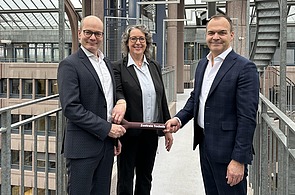
A historic moment for Zentrale Technik: for the first time in our history, we are led by a dual leadership team – Niels Dürr and Sabine Hahn succeeded Markus Landgraf, who has been promoted to Head of the Technical Division at ZÜBLIN. Sabine Hahn is the first woman to lead Zentrale Technik – a powerful sign of change and diversity in our leadership culture.
This development is also reflected in the figures: since 2005, the number of employees has quadrupled to 1,300. On average, we are 39 years old and women make up a remarkable 36 per cent of the workforce.
This development is also reflected in the figures: since 2005, the number of employees has quadrupled to 1,300. On average, we are 39 years old and women make up a remarkable 36 per cent of the workforce.
2024
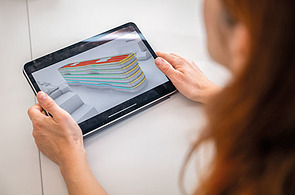
An important step towards the future: for the first time, we are bringing together all smart and sustainable cross-cutting topics in a single department: Connected Services. There, we are creating space for innovation and accountability – for digital solutions and sustainable construction across the entire lifecycle of buildings. Smart Engineering represents intelligent technologies and AI-based approaches that make processes more efficient and connect building structures. Sustainable Engineering considers the entire life cycle, reduces resource consumption and makes existing buildings fit for the future. With this new structure, we are sending a clear signal for progress and holistic thinking – smart and sustainable.
2017
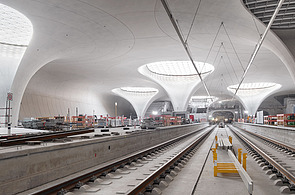
Stuttgart 21 is the mega-project right on ZÜBLIN’s doorstep. For its centrepiece, the new main station, we are responsible for manufacturing the 28 funnel-shaped supports. Each one is unique in terms of its angle, shape and height. This is where ZT’s multidisciplinary expertise comes into play: Following unsuccessful trials with moulded glass, we developed and manufactured 84 customised timber formwork components in collaboration with ZÜBLIN Timber. On 28 occasions, up to 32,000 reinforcing bars were installed with precision, and up to 780 cubic metres of light-coloured concrete were poured into the formwork each time – a feat of engineering that remains unrivalled to date.
2005
Following STRABAG’s acquisition of ZÜBLIN, the main technical administration department is renamed, and new planning and engineering service units from Vienna and the Cologne area expand the service portfolio. Under the name “Zentrale Technik”, STRABAG and ZÜBLIN benefit from the pooling of expertise across various specialist disciplines. The merger increases the number of locations; ZT begins to grow in a decentralised manner, strengthening our proximity to our clients. The service provided by Zentrale Technik, working in close collaboration with the operational teams and clients, remains a uniqueness in the construction industry to this day.
1994
By 1994, ZÜBLIN had been one of the leading companies in tunnel construction for almost 30 years – thanks to the talented engineers in our technical offices. 1994 marked the start of a series of milestones in tunnel construction. In Hamburg, the fourth tube of the Elbe Tunnel was constructed using the shield method. In 1995, construction began on the Engelberg Base Tunnel on the A81 in Leonberg. Zentrale Technik realised Germany’s largest-ever road tunnel cross-sections. From 1998, ZÜBLIN built Germany’s longest road tunnel, at around 7.9 kilometres, in the Thuringian Forest: the Rennsteig Tunnel.
1971
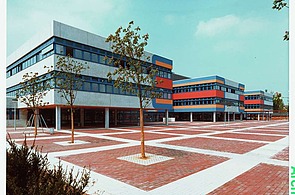
During the construction of the Landesversicherungsanstalt in Karlsruhe in 1959, ZÜBLIN used prefabricated cassette panels for the first time. Building on this, the Technical Office – the forerunner of Zentrale Technik – developed the 6M system, introduced in 1971, in collaboration with renowned architects. Within a few years, the 6M system became the most widely used prefabricated component system for multi-storey buildings in Germany.
1955
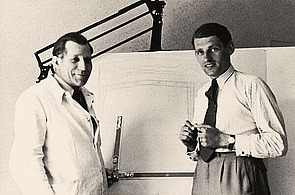
Professor Dr.-Ing. Volker Hahn is regarded as the founding father of today's Zentrale Technik. After working at ZÜBLIN for three years in structural engineering and three years as a construction site manager, Hahn set up the "Special Projects Office", which would eventually become the technical office at the HQ.