Satu Mare Bridge
-
A new urban landmark
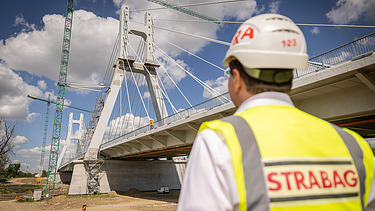
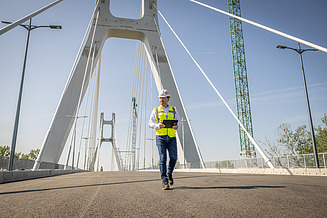
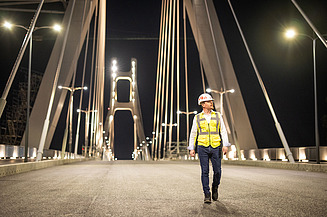
The Satu Mare Bridge serves as an important connecting element within the urban fabric. Its multi purpose deck accommodates vehicle lanes, pedestrian walkways and cycle paths running side by side. The elegant steel superstructure weighs approximately 230 tonnes and is supported by 56 high strength stay cables anchored to 73 metre high pylons. The bridge was built to improve connections between different parts of the city on both sides of the river, providing better access for motorists, cyclists and pedestrians, and thereby supporting economic development in the area. The total project investment amounted to around 40 million euros.
Precision and flexibility in the design of the Satu Mare Bridge
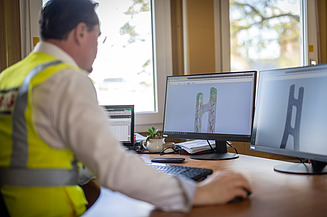
The implementation posed a particular challenge: due to the high sensitivity of the supporting structure in the various construction phases and equipment specifications – especially in the cable-stayed system – the design had to be adapted more than ten times in an iterative process. Zentrale Technik coordinated the interfaces between the construction site, suppliers and planning, and provided consistent technical solutions from the anchor plate to the top of the pylon.
High-precision technology was also used in this process: drone-mounted LiDAR technology was used to map the anchor plates of the pylons with millimetre precision. The point clouds generated were processed on high-performance servers, compared with the planning status and provided control points for machine control – the basis for the precise installation of the stay cables.
-
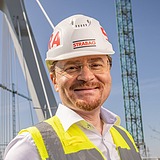
Only through the close integration of engineering expertise, digital methodology and construction-oriented design processes were we able to master the complex construction phases.
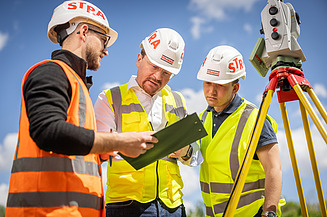
Construction driven design thinking
Zentrale Technik used a complete BIM 5D model to identify potential collisions at an early stage and to design efficient construction site processes. In conjunction with LEAN construction principles, this created a planning environment that made even the most complex tasks manageable. We also contributed our expertise in high-precision tensioning and angle correction of the stay cables, together with the necessary fine adjustments to the FE models. The construction methods chosen were also an expression of practical design: the 73-metre-high pylons were constructed using self-climbing formwork systems. The segmented bridge deck was assembled using heavy-duty cranes positioned on temporary platforms. Instead of a conventional cantilever solution, this allowed us to optimise the geometry, quality and construction time.
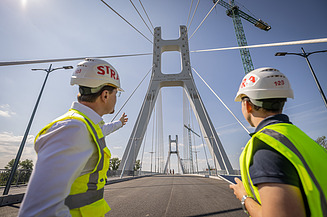
A farsighted bridge construction
The Satu Mare Bridge project is a prime example of the interdisciplinary strength of Zentrale Technik: civil engineering, structural engineering, geotechnical engineering, traffic safety and comprehensive quantity surveying across all project trades were seamlessly integrated into a unified workflow. In parallel, our team successfully incorporated state‑of‑the‑art technologies such as drone-based surveying, high‑resolution digital terrain models, and model‑driven planning checks, ensuring that digital insights directly supported each phase of the construction process.
With the successful completion of the bridge, we demonstrate how digital tools, design thinking, and technical excellence can complement one another to deliver complex infrastructure projects. The Satu Mare Bridge stands as a testament to how modern engineering methods and interdisciplinary collaboration can turn ambitious structural concepts into reliable and future‑oriented solutions.
Services
-
Engineering services according to HOAI
- Service Phase 5: Execution Design
- Service Phase 8: Construction Supervision
-
Smart Engineering
- BIM management
- Drone-mounted LiDAR scanning
- Point cloud processing
- Development of digital terrain models
- Model-based design checks